


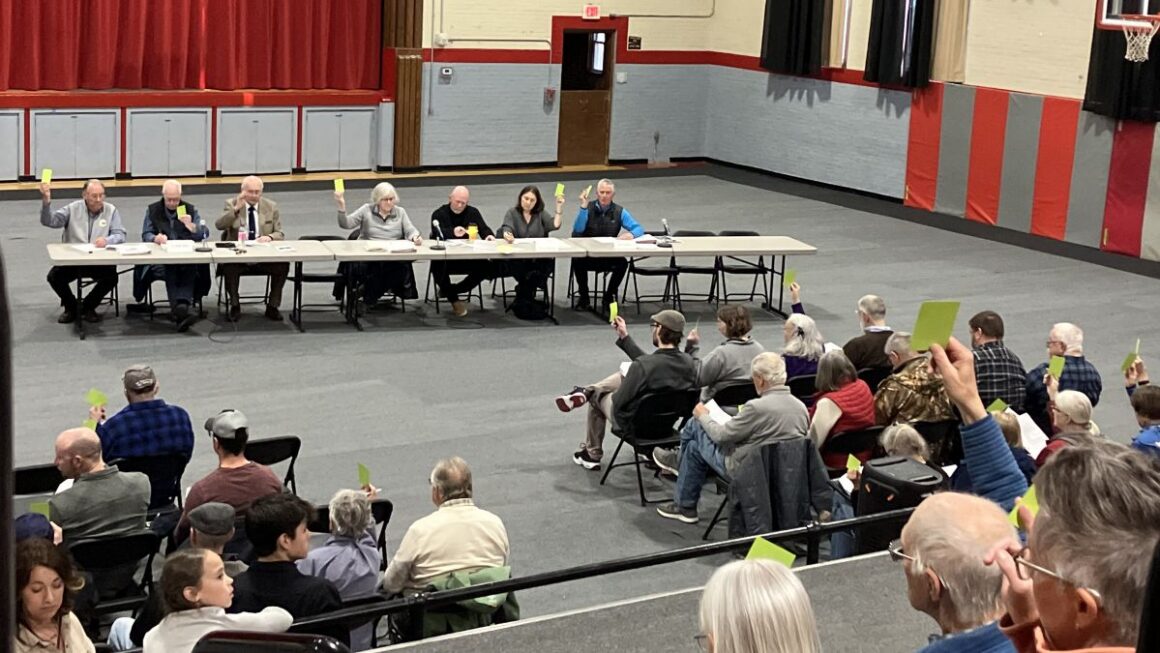
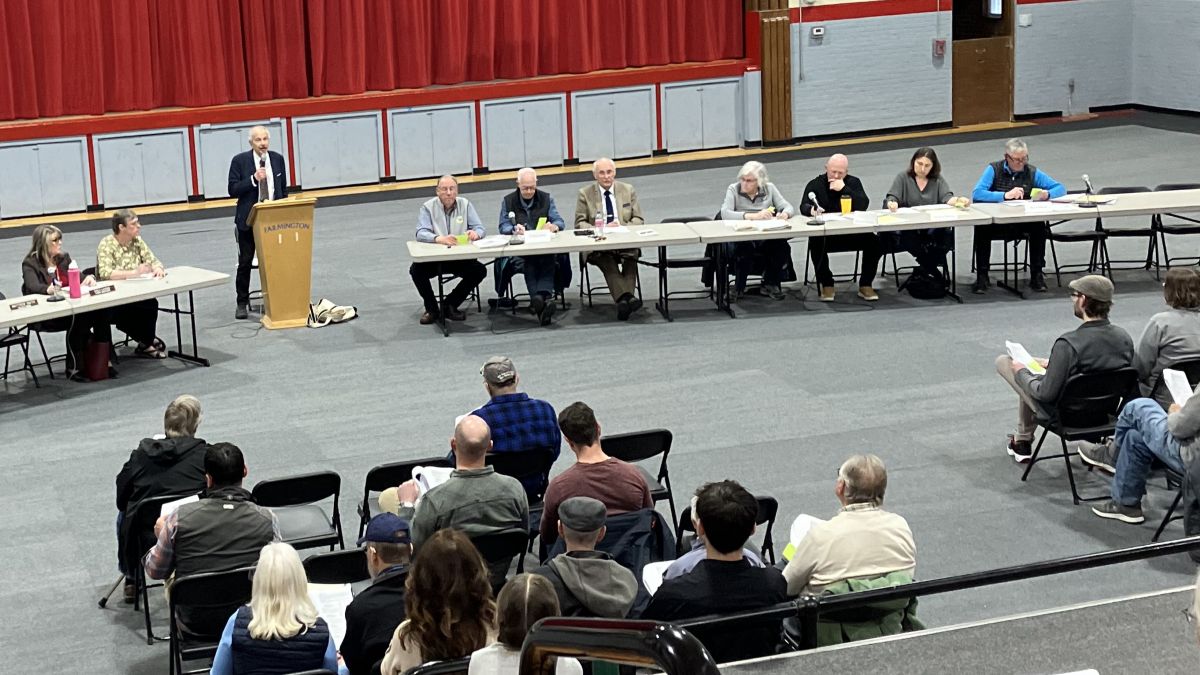
FARMINGTON — Returning to the Farmington Community Center for the second time this spring, voters at Monday’s annual town meeting approved purchasing a new ladder truck and backed a $4.2 million bridge project, while rejecting a proposal to cut permitting fees for marijuana cultivation facilities.
More than 120 people attended, moving quickly through budget articles with little discussion.
Most of the 90‑minute meeting focused on the final three items.
Residents voted to buy a new Pierce ladder truck to replace Tower 3, a 2007 Pierce model, after reviewing the Farmington Fire Rescue Department’s equipment needs and financing options.
Fire Chief Tim “TD” Hardy said Tower 3 has about 50,000 miles and 3,245 hours of operation – roughly the equivalent of 100,000 miles because the pump system runs while the truck is in use. “At this time, the truck currently in service is starting to show its age,” Hardy said, noting ongoing concerns about rust despite annual mitigation efforts.
Delivery times for new trucks range from 40 to 49 months, Hardy said, meaning Tower 3 will be 23 or 24 years old by the time the replacement arrives. He noted that fire departments typically replace ladder trucks every 20 to 25 years.
Hardy said the department plans to keep Tower 3 in service until the new truck arrives, then sell it. The town does not have space to store two ladder trucks and has shifted toward maintaining a smaller, regularly updated fleet rather than keeping older vehicles in reserve.
The eventual resale value of Tower 3 is uncertain because of the long wait before the replacement is delivered.
In response to a question about buying a used truck, Hardy said the market is thin. Few trucks newer than 2015 are available, and older models are typically too worn to offer much usable life.
“That doesn’t really get you very much life over the 2007 (Pierce fire truck),” he said.
If Tower 3 remains in decent condition until the replacement arrives, Hardy said the town could recoup some value through resale. For now, dealers are offering only $15,000 to $20,000 because of the long wait before Farmington receives its new truck.
The board placed an order for the new ladder truck in March to avoid further price increases. If voters had rejected the article, the town would have canceled the order.
The article authorizes using $745,000 from the fire apparatus capital account — about 10 percent of which will come from next year’s budget — and borrowing up to $1.58 million to purchase the new truck. With an estimated 4.83 percent net interest rate on a 15‑year bond, the total cost would reach $2.26 million.
Hardy and Town Manager Erica LaCroix described that figure as a worst‑case scenario. The Select Board will choose a financing package once lenders can make formal commitments, which could include a lower interest rate or a prepayment discount. They said banks would not provide firm terms until voters approved the borrowing.
The 15‑year bond keeps annual payments roughly equal to what Farmington typically sets aside each year for fire engines.
“We could definitely look at a shorter term,” LaCroix said. “The goal here was to be budget neutral, so that the $150,000 we’ve been putting into the reserve account every year would then equal the payment. If we shorten the term, the payment will be more than that and it will increase the taxes.”
Different financing options will be presented to the board, LaCroix said, adding that the town will seek the best possible deal for taxpayers.
Vice Chair Richard Morton asked residents with opinions on how the bond should be structured to contact town officials so the board has that input when it makes a decision.
Support for purchasing the fire truck was overwhelming after moderator Paul Mills called for a vote.
Voters also approved borrowing up to $500,000 for a multiuse bridge over the Sandy River. The project would connect the Whistle Stop Trail — a 14‑mile route from Jay to West Farmington — to Prescott Field.
Construction of the bridge, which would replace a rail bridge removed in 1989, has drawn interest in Farmington for more than 20 years. It is listed as a priority in both the Downtown Tax Increment Financing District plan and the town’s downtown development plan.
The bridge would accommodate pedestrians, cyclists, horses and snowmobiles. Although it could physically support all-terrain vehicles, state easements leading to the site do not allow that traffic.
The state Bureau of Parks and Lands would own and maintain the structure, but the High Peaks Alliance, or HPA, has led the effort as a way to connect regional trail systems to downtown.
HPA Executive Director Brent West said the project must undergo a National Environmental Policy Act assessment and secure permits before moving forward. He said he hopes the state can put the work out to bid in the spring. Construction could take one or two years, depending on whether crews can work around restrictions related to Atlantic salmon.
The project is expected to cost up to $4.2 million. With the proposed $500,000 bond and a previously approved $200,000 from the Downtown Tax Increment Financing District, Farmington would cover about 17 percent of the total. Federal, state and privately raised funds would pay the rest.
A 10‑year bond at 4.5 percent interest would cost $631,894. The bonding would be structured to take advantage of the retirement of debt associated with Engine 1, so it would not increase the mill rate. The town would borrow the funds only if the bridge is built.
“I’m very much in favor of this,” resident Ed David said, noting that the town would leverage significant outside funding in exchange for its investment. “It improves the quality of life. It improves the image of Farmington. It creates a destination along a 14‑mile corridor used for multiple recreational activities.”
Josh Bell, a member of the Downtown TIF Advisory Committee, called the bridge a great project and thanked West and the HPA for the time and energy put into moving it forward. As with the fire truck, voters overwhelmingly supported moving ahead with the bridge.
Residents were less generous to marijuana cultivators, voting in favor of a motion to reject changing the town’s ordinance. The proposal would have cut permitting fees for marijuana cultivation in half.
Farmington collects a little more than $29,000 annually from the five businesses that pay the fees. One of those businesses requested the reduction, arguing the fee structure was set arbitrarily and that, under state law, municipalities are supposed to recoup only the costs of licensing facilities, not generate revenue.
The board allowed the proposal onto the warrant without taking a position. Because the fee structure is written into the town’s ordinance, only residents at a town meeting can change it.
Morton said he opposed cutting the fees, noting they were established through a fair, deliberative process when the ordinance was created. A 50 percent reduction would be just as arbitrary, he said, and regulating marijuana businesses has become more complex.
Others also spoke against the reduction, and no one spoke in favor. In the end, residents supported a motion by Bell to not proceed with the alteration, effectively killing the proposal.
In contrast to the three final items on the warrant, the budgetary articles generated little comment.
The town is expected to shift next month to a fiscal year running from July 1 to June 30 and is now operating under a six‑month budget approved by voters in March.
Residents approved every article as recommended by the board, resulting — along with projected budgets for Regional School Unit 9 and Franklin County — in a $16,580,989 budget for the fiscal year. With an estimated $3.64 million in revenue, the town would need to raise $12.9 million in taxes, a 5.26 percent increase over the 2025 budget.
That would produce a projected tax rate of $12.10 per $1,000 of assessed valuation.
That is up 15 percent from the 2025 calendar year, with the caveat that last year’s budget was supported by $1.3 million from the undesignated fund. Had the 2025 tax rate not been supported by that one‑time funding, the increase would have been 3.4 percent.
At the average Farmington home valuation of $300,000, and assuming the projected $12.10 rate holds, that would mean two tax bills of $1,815 each, due Nov. 2 and May 3, 2027.
Farmington’s allocation makes up 45.1 percent of the $16.6 million budget. The projected assessment for RSU 9 accounts for 44.2 percent of property taxes, and Franklin County accounts for 10.7 percent.
Residents approved Farmington expenditures that will rise 1.7 percent compared to the 2025 budget. RSU 9’s assessment is expected to increase 6.2 percent, while Franklin County’s is projected to rise 21 percent.
The Select Board and Budget Committee recommendations accompanying each article were nearly identical. The board added $5,000 to the town’s legal reserve after the committee completed its deliberations. Committee members said they had been informally polled on the increase and supported it. The additional funding reflects the possibility of higher legal costs, largely tied to abatements following the recent revaluation.
Increases in municipal spending cover higher software and utility costs, along with volatile motor and heating fuel prices.
There is no cost‑of‑living adjustment because the six‑month budget already included a 45‑cent wage increase to match the state minimum wage. Going forward, the town expects such adjustments to take effect each July 1.
The meeting can be viewed here.