


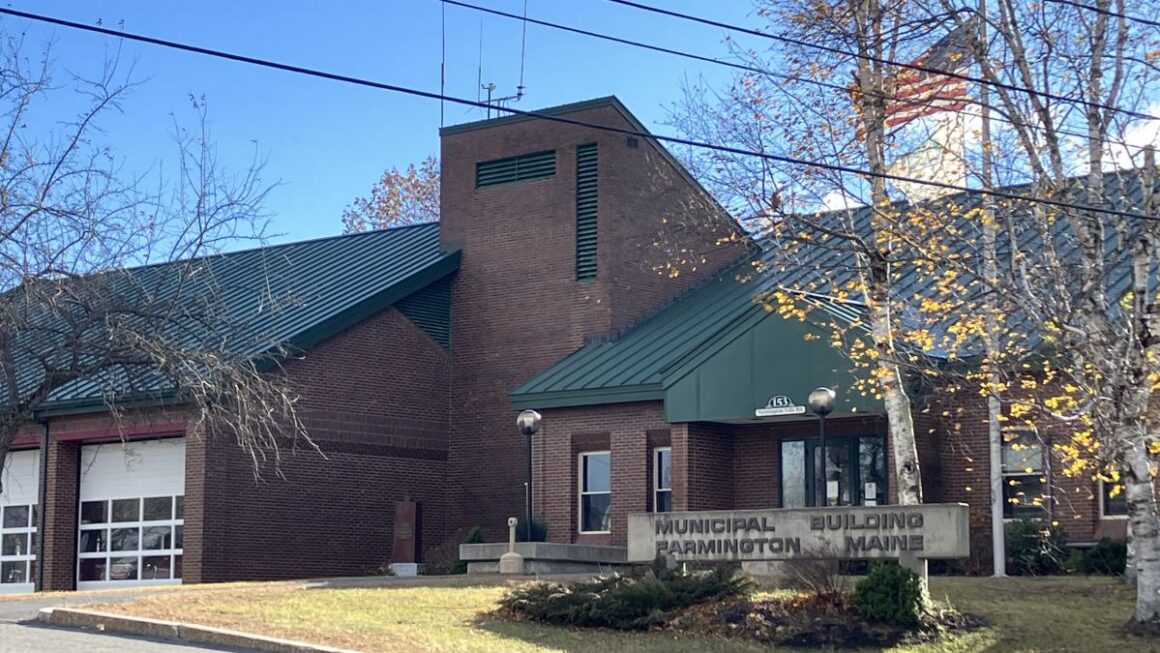
FARMINGTON — The Select Board approved a 3 percent increase to the sewer rate Tuesday and signaled it may adopt a similar increase next year.
The board unanimously approved the increase after hearing the Wastewater Department’s budget presentation. Although department expenditures are rising only slightly, a drop in revenue from system users prompted the rate hike.
The department proposed $1,281,286 in expenditures, an increase of $7,511 from the 2025 request — the last time Farmington operated on a full fiscal year before the six‑month transition budget that began Jan. 1, 2026.
Higher costs for health insurance, electricity and treatment chemicals were largely offset by savings in professional services, as the department plans less televising of sewer lines this year. The capital improvement budget is also down $25,000, with planned purchases limited to replacing a desktop computer with a laptop and starting work on a three‑bay garage to be built above flood level.
The department generates most of its revenue from roughly 1,100 users, who previously paid a base rate of $48 per quarter to the town. Consumption is then tracked by water usage: after the first 500 cubic feet of usage, ratepayers previously paid an additional $9.60 per 100 cubic feet.
After looking at the first half of this year’s department revenue, Town Manager Erica LaCroix said that she wasn’t comfortable projecting any more than $1.2 million in revenue if the rates held steady.
There has been a downward trend to the revenue numbers over the past few years, which Wastewater Superintendent Joe Hartigan said related to more efficient systems and practices, particularly among some of the town’s bigger users, such as the University of Maine at Farmington, MaineHealth Franklin Hospital and commercial property owners. The town projected $1.27 million in revenue in 2025 and received $1.25 million instead.
“I was concerned that the continued decline in revenue is substantial,” board member Dennis O’Neil said.
Adding in some other, smaller revenue generators, LaCroix said that the department’s total revenue would project to $1.24 million. That would leave a deficit of $46,000 over the next fiscal year.
If the department runs a shortfall, it can be covered out of its fund balance. That balance was at $1.6 million at the end of last year. It represents all of the department’s savings, however; there isn’t another significant reserve to cover an unexpected project or repair.
While the revenue may keep decreasing, town officials noted that the system was not losing significant numbers of users. It would be difficult to cut the budget in future years, LaCroix said.
“We know the costs are going to continue to rise,” she said. “Labor rates aren’t going down. The cost of goods and services is not going down. So we can expect our budgets are going to be very hard to keep flat.”
That was particularly true for infrastructure-heavy budgets like the Sewer Department, she said.
The last rate change was in 2023. LaCroix said that consistent, small increases could avoid some of the complications that accompanied larger ones, citing the town’s long overdue reevaluation as an example.
LaCroix drew up a number of scenarios for the board to consider, ranging from doing nothing to implementing a 5 percent increase. Examples in which the board only raised the minimum rate did not generate enough revenue to meaningfully close the gap.
O’Neil proposed a 3 percent increase, to both the minimum and the consumption rates. That would close the projected deficit to less than $16,000, which O’Neil said could be covered through savings over the course of a year.
“That deficit doesn’t scare me particularly, but (this increase) gets us a lot closer to having a balanced budget at the end of the year without having to use reserves,” O’Neil said.
That increase would result in a $2.98 per quarter increase for a median user in Farmington, or an average increase of $8.79. The biggest user is the University of Maine at Farmington, which would see a $787 increase per quarter. That rate is projected to generate $1.3 million in revenue.
Chair Matthew Smith and Vice Chair Richard Morton agreed with 3 percent this year but also discussed another 3 percent increase next year. That would represent a 5 percent increase over two years to close the gap, plus a 1 percent increase for fiscal year 2027-28.
The board moved unanimously to approve the 3 percent increase to the rate as well as the proposed sewer department budget.
In other business, the board also unanimously approved a change order for the work being done on the Hippach Field wall. The town is seeking a mason to restrike and mortar the interior center wall where the preexisting mortar is brittle or missing. The wall’s foundation is believed to be in good condition and will be left intact.
That work would take down the existing top caps and their five decorative spheres — one of which is cracked in half — and put up granite replacements, which are cheaper than precast concrete ones. That refurbished wall will match the new sections that are being constructed on either side, replacing the slat fence.
“We can’t leave that up with that crack there,” Smith said of the decorative sphere. “We have to take it down and do something with it. It’s a safety issue.”
Public Works Director Phil Hutchins noted that the planned examination of the wall was the reason that the inspector found rot in the nearby grandstand’s support beam. Those wooden support beams will be replaced with steel ones this summer.
The cost of the change order — $74,020 — could be covered out of the capital reserve or from funds earmarked for the wall from the Bjorn Foundation.
Morton thanked the recreation and public works departments and LaCroix for fielding questions and concerns from the public about the wall.
“I think that the end result, as long as the mason does as good a job as we’re hoping, is exactly what we should have been attempting to do,” Morton said. “Have a safe, attractive wall that pays respect to history but doesn’t necessarily replicate it. I think it’s a noble goal. It’s the right goal.”
The board also recognized the town’s longstanding code enforcement officer for 40 years of service with a plaque and a brief ceremony. J. Stevens Kaiser began working for Farmington in 1986.
“It must be a great place to work,” Kaiser said. “Otherwise I wouldn’t have hung on this long.”
The board approved a $2,822 carryforward in the Code and Planning Office. That will allow the department to pay an intern to complete her work on updating the town’s comprehensive plan, which is due for renewal next year.