




In late May, a woman called Sanford police for help with a domestic dispute involving her ex-husband. He had threatened to harm himself and their son, and had machine guns and handguns in his home.
The officer told her to petition for a red flag order, which starts a legal process where a judge can order law enforcement to temporarily remove weapons from those deemed to be a danger to themselves or others.
The woman hadn’t heard of this process before, she told The Maine Monitor. She filed an emergency petition at the District Court in Biddeford, and a judge granted it the same day.
The woman is one of five people who have petitioned a judge for a red flag order against a family member since the law went into effect six months ago. Maine’s extreme risk protection order law, or red flag law, was passed via ballot referendum last fall, making Maine only the second state in the country to enact such a law through citizen action.
Its passage came almost exactly two years after a shooter, an Army Reserve soldier named Robert Card, killed 18 people in Lewiston. The gunman’s family had called law enforcement and the military several times to warn them about Card’s increasingly erratic behavior in the weeks and months leading up to the shooting. Card spent nearly three weeks at a civilian psychiatric hospital in New York where he had been attending Army Reserve training the summer before the October killings.
A state commission investigating the Lewiston shootings wrote in its final report that there were myriad opportunities for law enforcement, which seldom used Maine’s existing yellow flag law before the shooting, to take weapons away from Card. Gun safety advocates responded by pushing for the state to adopt a red flag law, which gives family members — not just police — the ability to petition the courts directly to remove weapons.
In addition to the Sanford woman, two petitions were filed by parents of adult children; one was filed by a former spouse; and one was filed by a current spouse. Three law enforcement agencies –– from Paris, Fairfield and Falmouth –– have also sought red flag orders, for a total of eight petitions since February.
The Monitor is not naming the family members who requested the red flag orders or the individuals who had orders filed against them because of the nature of the cases and because red flag orders are civil and not criminal matters.
Advocates of red flag laws have said they provide a way for family members to act quickly to get dangerous weapons out of their loved one’s hands.
The Sanford woman requested an emergency order, and, given the threat of immediate danger, the judge granted it without her ex-husband at the initial hearing. Law enforcement was then instructed to immediately remove weapons from her ex-husband’s possession and restrict him from obtaining new weapons.
At a follow-up hearing on the red flag order six days later, a judge denied her request to extend the order for a full year, finding that there wasn’t enough evidence that the man presented a continuing risk to his family or himself, the Sanford man’s court-appointed attorney, Kathy McKechnie, said.
But the woman had also filed for a protection from abuse order to prevent him from contacting her, and that was granted, she said.
“There was a lot of behavior that was concerning, and so we just threw everything at the wall to try to, you know, see what was going to stick as soon as possible,” the woman said.
In a different instance in Somerset County, a woman said that her adult daughter had been off of her medications to treat bipolar disorder for a month and had experienced extreme stressors in her life recently. Her daughter told her she had put a deposit down on a gun at a nearby shop.
In her petition requesting an emergency red flag order, the woman wrote, “I need her to be flagged in some way on the background check because of mental instability.”
A judge granted the emergency order. Eleven days later, the judge granted a non-emergency order, which will remain in place for a year.
In another case involving the parent of an adult child, a woman sought an emergency order for her son, who had been drinking heavily and making suicidal statements. She had put her son’s cache of rifles and pistols in her car and was ready to drop them off at the nearby police station when a Westbrook police officer, who was at their shared residence to serve her son a summons for operating under the influence, advised the mother to file a petition.
A judge granted both the emergency and non-emergency orders.
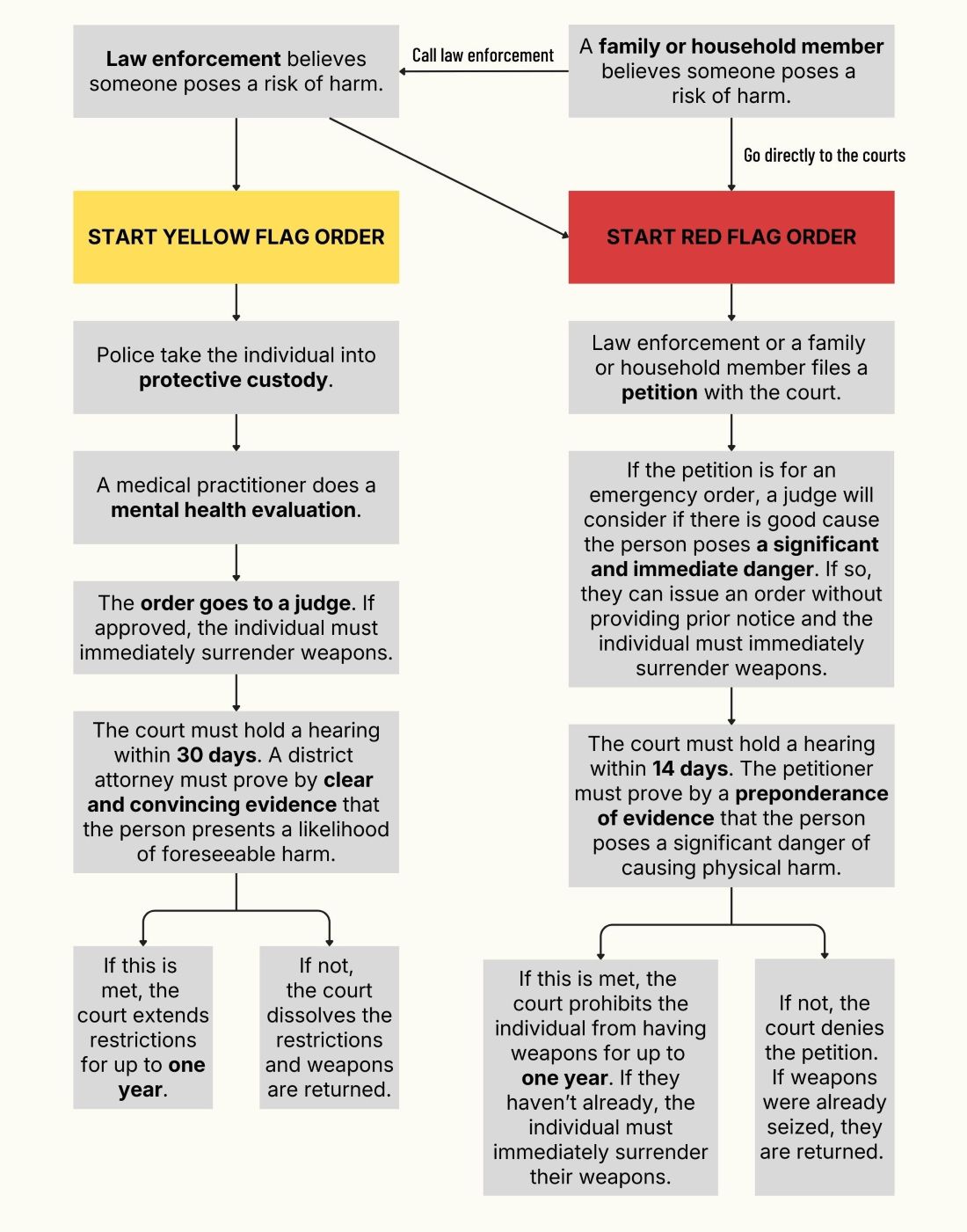
Maine’s red flag law allows both law enforcement and close friends or family members to directly petition the courts to take weapons away from a person at risk of harm to themselves or others. It exists alongside the state’s unique yellow flag law, which passed in 2020 and saw little use before the Lewiston shooting.
A yellow flag order can only be initiated by law enforcement and requires that an individual be taken into protective custody and given a mental health evaluation before a judge can issue a ruling. Red flag orders do not require either of these steps, just proof that the person poses a significant danger of causing physical harm.
There are two types of red flag orders: emergency and non-emergency. Emergency orders are reviewed by a judge the same day they are filed and can be issued without the subject present. In either instance, a hearing must be held within 14 days of when a petition was filed, at which point a judge decides to either dismiss the case or issue an order for a year.
Use of the law has not been without pushback. Seth Berner, the court-appointed attorney for the Westbrook man whose mother filed a red flag petition, said he did not believe the mother adequately established that his client posed a current or future threat of harm.
Berner, who has represented one other person in red flag proceedings, said he did not know if his client would file a motion to dismiss the order. But having represented a number of people in yellow flag proceedings, he said that getting a judge to dismiss an order early is a “tough mountain to climb” because the subject of the order carries the burden to prove they are no longer a risk.
People are permitted to file a motion to dismiss an order against them once during its duration.
After a judge granted Paris police’s petition for an emergency order against an Oxford County man, the man’s attorney, Mark Gillies, filed a motion to dismiss it, citing an often-used argument by detractors that the law strips individuals of their due process rights. Paris police argued that officers had responded to multiple calls involving the man and were told by family he had a history of psychotic episodes in which he would get violent.
Paris Chief of Police Michael Ward told The Monitor in April that officers were not able to get the man into protective custody, the required first step in a yellow flag order, and that “there was enough totality of the circumstances that we went forward with the red [flag order], and the judge agreed with us.”
A judge denied the motion to dismiss, and the case is still pending.
In at least three different petitions submitted by family members, they wrote that a law enforcement officer had advised them to seek a red flag order.
That law enforcement officers apparently chose to not petition for the red flag order themselves piqued the interest of Lisa Geller, who co-leads the National ERPO Resource Center at Johns Hopkins University in Baltimore, because it differs from what she has seen in other states.
“I know the numbers are still really low, but there’s not a single state that has more family initiated petitions as opposed to law enforcement-initiated petitions,” she said.
Twenty-one other states, the District of Columbia and the U.S. Virgin Islands have enacted red flag laws. The only other state to have both a red flag law and a law similar to Maine’s yellow flag law is Delaware.
Geller said she wonders if law enforcement officers in Maine are continuing to use the yellow flag law because they are more familiar with it, especially since the uptick in its use since the Lewiston shooting in October 2023. In the six months since the red flag law went into effect, law enforcement agencies have successfully petitioned for more than 255 yellow flag orders.
The National ERPO Resource Center trained about 15 law enforcement officers, most of whom were police department chiefs, and about 30 others who work with vulnerable populations, including social workers, domestic violence and suicide prevention advocates and defense attorneys, at the University of Maine at Augusta in May, on how to use the red flag law, Geller said.