



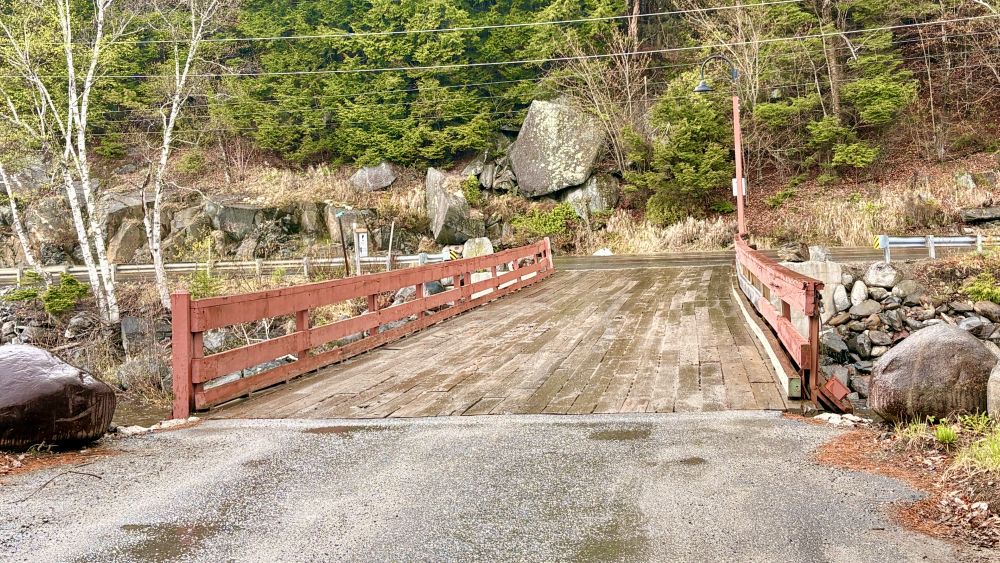
KINGFIELD — Several residents raised concerns Monday during a public hearing over language in a petition seeking a moratorium on transient overnight recreational developments, specifically targeting a Bowdoin College proposal to allow overnight camping at the Finnegan McCoul Woodruff Mountain Center near Ira Mountain.
Voters are expected to consider the moratorium at a meeting scheduled for 6 p.m. Monday, July 13, at Webster Hall.
Early this year, the Brunswick liberal arts college proposed building up to seven gravel campsites for 28 tents — for up to 112 students — on the more than 20-acre property, prompting abutting property owners to raise concerns about noise and potential damage to a single-lane bridge leading to Iron Bridge Road.
The college had hoped to open the campground for about 84 student campers in August and for September orientation activities, but it withdrew its application in May after residents requested the Board of Selectmen consider a 180-day moratorium to update the town’s transient overnight camping ordinance.
The petition defines overnight camping as “a form of organized camping and recreation involving accommodation and facilities similar to, but distinct from, those associated with a campground.”
That language raised concerns that revising the ordinance could affect short-term rentals and bed-and-breakfast operations, because the common definition of “transient overnight recreational development” generally refers to stays shorter than 30 days. However, the proposed moratorium lacks that definition, and current town ordinances do not include the term “Airbnb,” illustrating the outdated nature of the local rules.
The Board of Selectmen faces a challenge because the town must present the article to voters exactly as written in the petition. State law denies the board the authority to alter the language.
The restriction creates a problem for residents seeking clarity on what the ordinance includes or excludes. The petition, for example, states that all transient overnight recreational developments are “prohibited” within Kingfield and that “no person or organization shall develop or operate” them.
Planning Board member Rob Woodhouse said the phrase “transient overnight recreational development” is not used in any other small town in Maine.
If passed, the moratorium would be retroactive by 45 days. Because the language does not specifically mention short-term rentals or bed-and-breakfasts, officials say those operations should not be affected.
The petition also addresses enforcement. Because Kingfield lacks a constable, the code enforcement officer would oversee the ordinance if it passes. Violators could face daily fines, and the only venue for appealing code violations would be in court.
Kingfield resident Marie Daigle noted that existing lodging businesses would feel more comfortable if the scope were better defined.
“The authority who is going to be enforcing it is going to have their own interpretation of it,” Daigle said, adding that concerns will remain if the code enforcement officer interprets existing lodging as a transient overnight recreational development.
Town Manager Leanna Targett said an ad hoc committee is being formed, in anticipation of the moratorium passing, to research which transient overnight stays should be restricted and which should be allowed within the town boundaries.
“There is so much more that needs to be looked at,” she said, noting that a comprehensive plan must go hand in hand with fixing local ordinances, which voters would consider at the same time.
The committee includes Targett, Woodhouse, Code Enforcement Officer Ben Hitchcock, and Planning Board Chairman Richard Hawkes.
During the hearing, some residents questioned Bowdoin’s motivation to withdraw its campsite application, suggesting the college risked facing a permanent ban if Kingfield passes a moratorium and updates its ordinances. Others, however, viewed the withdrawal as a gesture of good faith.
In a May email to Targett, John Simoneau, Bowdoin’s director of capital projects, wrote that the college still views the Bowdoin Outing Club proposal as a “modest” and “well-considered” project that deserves approval. However, he said the college chose to “voluntarily withdraw (its) pending application” in response to public concerns about whether the town’s ordinances adequately cover the development.
He also said the college intends to refile its proposal later this year, hoping that, with the town’s support, “we would have an opportunity to move forward with a project that is small in scale, serious in purpose, generous in its community commitments, and likely to create lasting appreciation for this remarkable corner of Maine for generations to come.”
Woodhouse suggested changing the language in the definition of a campground to specify overnight stays “with or without a fee.” The adjustment would allow approval of Bowdoin’s project because the college will not collect fees at the campsite.
Targett said the board cannot initiate an addendum or amendment to the petition as submitted because state law requires it to be presented to voters exactly as written.
“Because someone created this (proposed ordinance), not the town, we are not able to just go and fix it,” she said.