



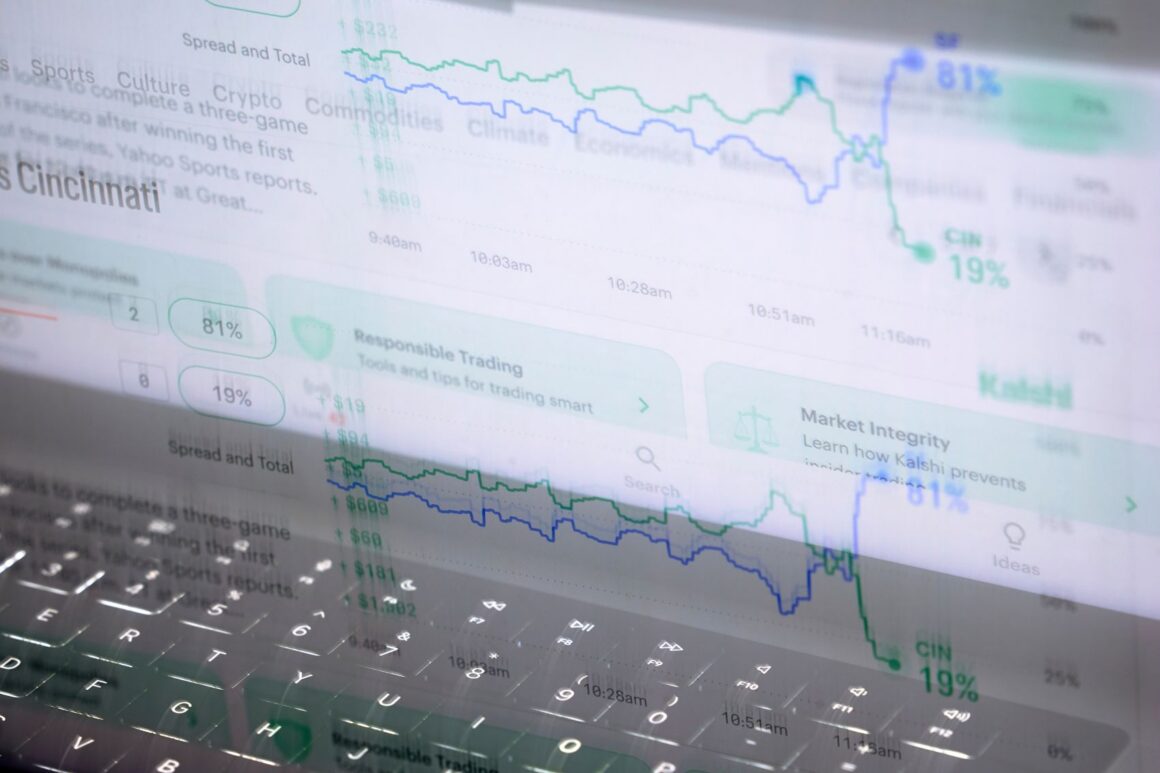
People have wagered tens of millions of dollars on Maine’s upcoming election on the financial trading platforms Polymarket and Kalshi, an amount that will likely continue to grow as November approaches. As these platforms make headlines and face new scrutiny, it’s worth understanding how they work and why they’re getting so much attention.
Here’s what you need to know:
What is a prediction market?
A prediction market, such as Polymarket or Kalshi, is an online platform where users trade money on predictions about current events. People buy “event contracts” that are tied to the outcome of a particular real-world event, such as who will win the Senate race in Maine, who will be the next person to leave President Donald Trump’s Cabinet or whether “The Odyssey” will take home an Oscar for best picture.
Users can buy “yes” contracts or “no” contracts that are priced somewhere under $1; the prices are determined based on demand and reflect how likely people believe the outcome to be. If a “yes” contract is priced at $0.60, that indicates that the market thinks there is a 60% chance of the event happening. The corresponding “no” contracts would be $0.40.
Once an event occurs and the outcome becomes clear, the question is closed and users who wagered correctly receive $1 for each contract they purchased, making money from those whose predictions were incorrect. Traders sometimes sell their contracts before the market closes to cut their losses, or to make money from changing odds and accrued interest. The sites make money by adding a small fee to purchases.
Are these markets legal?
It’s complicated, and fights are playing out in courts across the country.
At the moment: Polymarket’s international markets are banned in the U.S., but the platform has a separate app for U.S. users. Some U.S. users also access the crypto-based, offshore version of the platform using virtual private networks, or VPNs, that mask their location. Kalshi won a legal victory in 2024 when it successfully sued the Commodity Futures Trading Commission by arguing that its trader-set odds made prediction markets fundamentally different from the house-set odds that characterize gambling. It is now federally regulated by the commission.
Under the Trump administration, the CFTC has treated prediction markets favorably — causing concerns among critics of the sites. In June, Senators John Curtis and Adam Schiff wrote a letter calling on the CFTC to investigate prediction markets more deeply, stating that “there is little basis for treating them differently from gambling.”
A number of states have attempted to ban the sites through existing restrictions on sports betting. But the CFTC argues that the sites should not be subject to state-level gambling laws, and Kalshi has sued several states for proposing legislation that would affect prediction markets.
Why are prediction markets getting so much attention?
As the lawsuits are playing out, prediction markets have surged in popularity, in part thanks to their expansion into sports games and pop culture. Kalshi gained 3 million new users over the course of the World Cup, and hit a new record for market volume after over $1.8 billion dollars were traded on the tournament’s final game. As the user base has grown, political markets have seen greater participation, and some have turned to them as an alternative way of measuring public sentiment.
One challenge of these decentralized online markets is the risk of insider trading. This spring, a special forces soldier was charged with using classified information about the capture of the Venezuelan president to make more than $400,000 on Polymarket. Polymarket and Kalshi both ban insider trading in accordance with U.S. law, but it remains difficult to enforce. Since May, Kalshi has tried to crack down on insider trading on political markets by preventing people from making election-related trades if the Federal Election Commission lists them as working for a related campaign.
How much money has been wagered on Maine races so far?
In Maine’s June primary elections, Kalshi’s prediction markets ended up with nearly $1 million wagered on the outcome of the Democratic governor’s primary and $6.8 million dollars on the Democratic Senate primary. Polymarket, meanwhile, had $365,733 on the governor’s race and $3.7 million on the Senate race.
And people weren’t only betting on who would win — they were also placing wagers on who would get certain endorsements, how many people would vote, what the margin of victory would be and more. Graham Platner’s status, in particular, drew high volumes of bets. Questions about whether and when he would drop out of the race saw more than $10 million in bets on Kalshi and almost $2 million on Polymarket. People also had thoughts on who would replace him, wagering more than $5 million on Kalshi and nearly $1 million on Polymarket before Troy Jackson was officially chosen on July 25.
Looking ahead to November, the Maine Senate race is already garnering large bets. On Kalshi, people have wagered at least $8 million across two markets on which candidate will win (with Jackson currently favored at 63 percent). Nearly $9 million has been wagered on whether the Democrats will take control of the U.S. Senate, with the current likelihood at 47 percent.