


FARMINGTON — Voters swiftly approved the Regional School Unit 9 board of directors’ recommended $46.2 million budget Tuesday evening, sending it to a June 9 validation referendum.
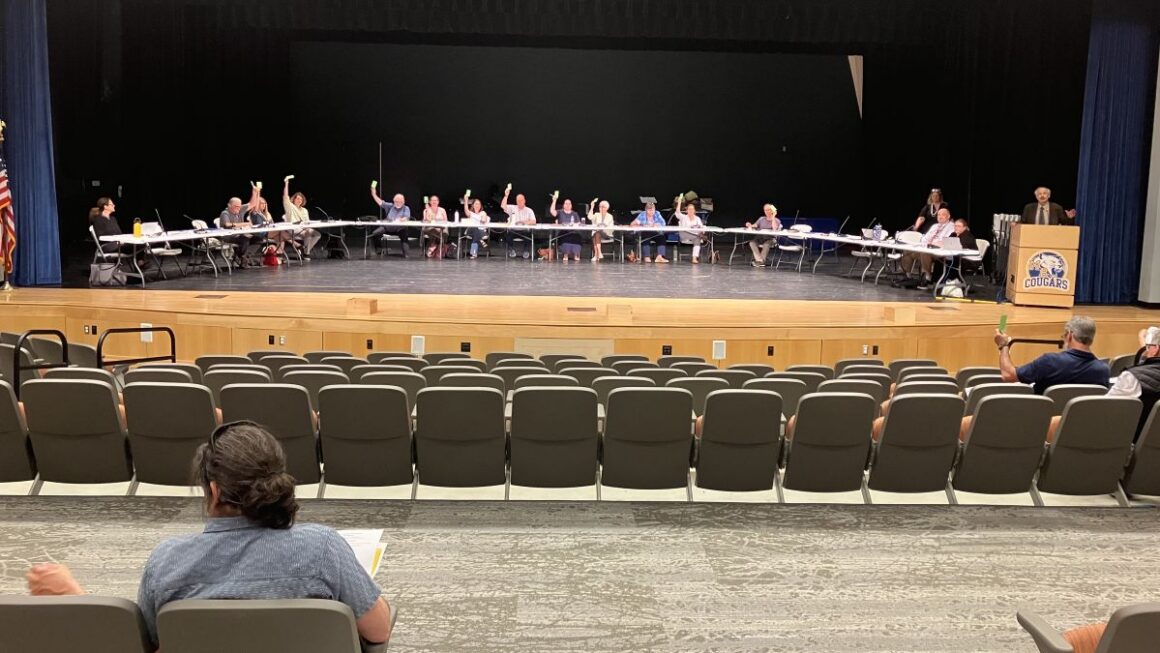
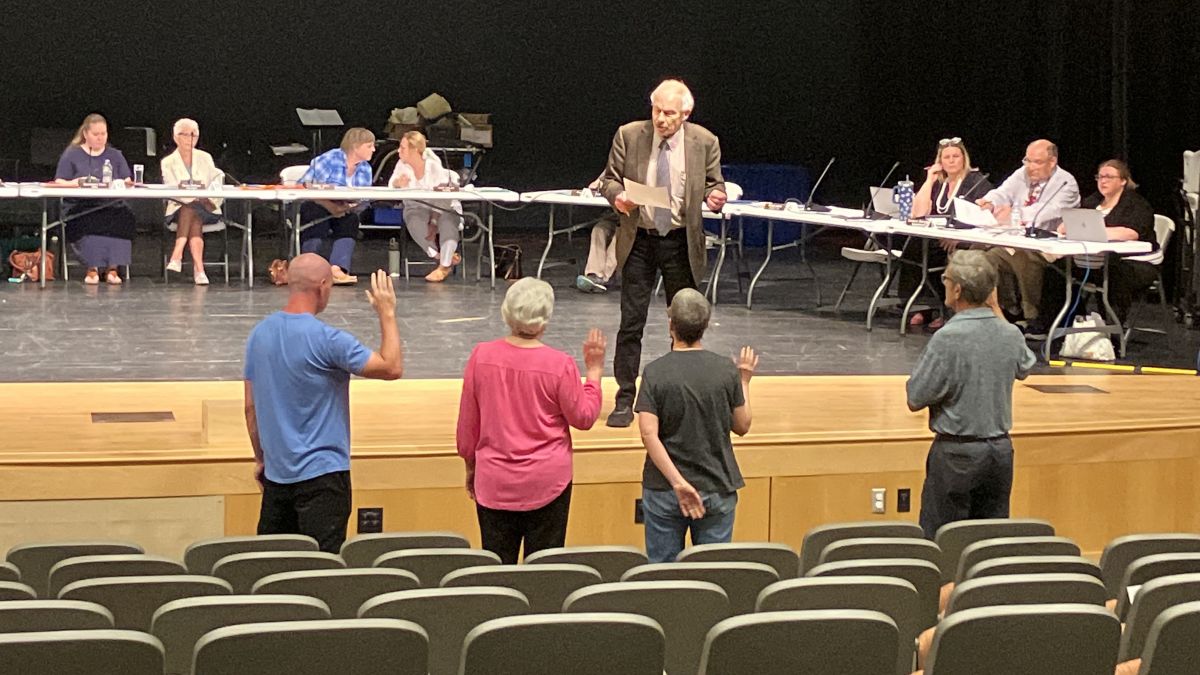
About 40 people, including school board directors, attended the May 26 meeting. Most votes called by moderator Paul Mills appeared to pass unanimously.
Voters approved the article that sets the district’s contribution beyond the state’s Essential Programs and Services allocation model by written ballot, as required by law. The measure passed 38-2.
The proposed $46,229,943 budget is up $681,547, or 1.5 percent, from the current fiscal year.
Of the $46.2 million budget, the state is expected to contribute $27.2 million and the towns $15.4 million. The district plans to use another $1.2 million from its fund balance and will carry forward $750,000 to support the Foster Career and Technical Education Center. It is also expected to use $1.64 million from other revenue sources, including tuition paid by students who live outside the district and MaineCare reimbursements.
The regular instruction cost center was approved at $12.7 million, a 2.91 percent decrease from the current fiscal year. The reduction stems largely from fewer teaching positions and staff retirements, which typically replace employees at the top of the pay scale with those who earn less.
The budget eliminates six positions: a math teacher and half of a science position at Mt. Blue High School; three classroom teaching jobs at Academy Hill School, G.D. Cushing School and W.G. Mallett School; and a districtwide custodial position. The teaching jobs were held by staff members who are retiring or otherwise leaving at the end of the year.
The budget adds one position by making permanent a Cascade Brook School teaching job created last year on a one‑year basis. It also increases a gifted and talented position from three‑fifths to full time.
Special education was approved at $8.3 million, a 3.46 percent increase. Part of that increase comes from shifting two coordinators out of grant funding to avoid losing another $40,000 in retirement money to the federal government.
The district said previously that the increase was the lowest for special education in western Maine.
Career and technical education totals $4.6 million, up slightly more than $300,000, or 7.1 percent, and funded entirely by the state.
Voters approved a 5.75 percent increase for System Administration, bringing that cost center to $1.6 million. Technology needs drive the increase, including $33,000 to update Wi‑Fi access points, $30,000 for a consultant to support the new employee assigned to the district’s PowerSchool database and $27,000 for higher subscription costs.
Transportation and buses total $3.2 million, a 1.48 percent increase.
Responding to one of the few questions asked Tuesday evening, Superintendent Christian Elkington said the district locked in a favorable propane price, which powers more than half of its bus fleet. RSU 9 has not been able to set a diesel rate, which has risen globally in recent months, but the district maintains a reserve account it can use if needed.
The facilities and maintenance cost center was approved at $5.1 million, down 0.57 percent from last year. Administrators cut $750,000 out of the initial proposal by moving repair projects into the current budget and using $250,000 from the capital reserve.
Franklin County Adult Education’s budget was set at $724,000, up 22.6 percent from the current fiscal year, which saw a modest reduction. That figure is not included in the $46.2 million school budget. The increase to that program is offset by money from adult education’s fund balance, and the local share will remain $212,875.
If validated at the June 9 referendum, the RSU 9 budget would result in a 1.29 percent increase in town assessments.
The budget would lower assessments to support RSU 9 in four towns: Weld at $602,000, a drop of $58,061, or 8.8 percent; Temple at $468,000, down $24,259, or 4.93 percent; New Sharon at $1.1 million, down $25,885, or 2.29 percent; and Industry at $1.11 million, down $5,018, or 0.45 percent.
Six towns would see increases: Starks at $638,000, up $28,999, or 4.76 percent; Vienna at $847,000, up $31,730, or 3.89 percent; Farmington at $5.71 million, up $209,161, or 3.8 percent; Chesterville at $1.23 million, up $19,613, or 1.62 percent; New Vineyard at $923,000, up $14,346, or 1.58 percent; and Wilton at $3 million, up $8,206, or 0.27 percent.
The proposed RSU 9 budget of $46.2 million is scheduled to go to referendum June 9. Voting is set in all 10 towns from 8 a.m. to 8 p.m., coinciding with the statewide primary.
A “yes” vote approves the action taken at Tuesday’s meeting and sets the budget. A “no” vote rejects it and sends it back to the board.