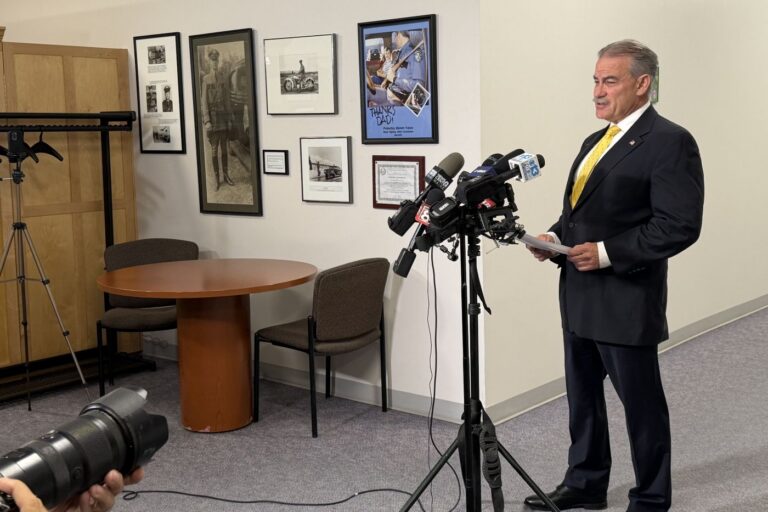




MACHIAS — In a special meeting Thursday morning, Washington County commissioners voted 2-1 to terminate County Manager Renée Gray just short of three years on the job.
Gray has been serving as deputy county manager and then county manager since July 2023, before which she was the town administrator in Lubec and had served for six years on the Washington County Budget Advisory Committee.
Commission Chairman David Burns convened the meeting at 9 a.m. Thursday, after which he made a motion to go into executive session to discuss the possible resignation of an unnamed employee with legal counsel. After 50 minutes, commissioners returned to the regular meeting and Burns made a motion to terminate Gray, as of July 22.
Commissioner Billy Howard voted in favor; Commissioner Courtney Hammond was opposed.
Gray was included in the closed door meeting.
No cause was given for the termination.

In a call to the commissioners’ office following the vote, Administrative Assistant Carla Manchester said the termination date was based on the required 20-day written notice of termination contained in Gray’s contract, counting out from Thursday’s vote.
According to Gray’s contract, which was provided to Monitor Local by the county, her salary started at $81,800 based on an initial six-month probationary period, with annual increases to be determined by commissioners. The contract, signed by Gray and former commissioners Christopher Gardner, Vinton Cassidy and John Crowley Sr. on July 24, 2023, provides for her to continue to be paid her full salary and benefits for 60 days after the date of termination, unless Gray finds employment within that 60 day period.
Burns declined a request from Monitor Local for comment, including whether Gray would be expected to work during the 20-day termination period.
Gray responded to a message from Monitor Local later in the day, but declined comment.
During her tenure with the county, Gray has frequently offered testimony to the Legislature on issues important to Washington County, including efforts last year to split the shared prosecutorial district of Washington and Hancock counties and assign Washington County a designated district attorney.
She also successfully pushed the commission to livestream its meetings, and to provide meeting materials to the public before meetings if requested.
According to legislative testimony Gray offered in March this year in support of a bill that included a special one-time payment of $640,671 for the state to pay the Unorganized Territory’s’ portion of the county’s 2025 tax anticipation note debt, she began her career in government in 2007 as a municipal counter clerk in Lubec, working her way up to town administrator in 2017.
An emergency medical technician and a native of Washington County, Gray has spent decades with Downeast EMS, is an active member of the Maine Association of County Managers, Administrators and Clerks, and an ex-officio member of the Sunrise County Economic Council.
For more than a year, Gray has been managing the financial crisis in Washington County, which was the result of years of mismanagement by former county officials.
According to Gray’s March testimony to the Joint Standing Committee on Taxation in support of the UT payment, during the 2024 budget process the county’s auditor made commissioners and then-Treasurer Jill Holmes aware of a poor practice of transferring unspent funds, or “carryovers,” into the next year’s budget. It was a practice that had been in place for at least five years prior, and was done without accurate accounting or annual audits. The result, Gray told the Legislature, was that “Washington County government did not tax enough to the municipalities to cover the budgets for 2020-2024,” creating a $2.6 million shortfall at the time, and a growing financial crisis that erupted last summer when county officials realized the debt could reach $8 million by year end.
According to Gray, the shortfall was masked by the presence of American Rescue Plan Act funds in the county’s general account, money that was improperly used to cover cash flow.
In 2025, county leadership changed when two new county commissioners were elected — Burns and Howard — and Gov. Janet Mills appointed Hammond to the open District III seat.
Holmes, who had served as elected treasurer since 1999, resigned in September 2025, citing personal reasons for her departure.
Around the time of her resignation, Washington County officials said Holmes had moved $400,000 of taxpayer money improperly, transferring money that should have gone toward services in the Unorganized Territory, into the county’s regular accounts. State law requires money for the UT to be kept separate from general spending.
Those incorrect deposits helped obscure years of cash flow problems that were finally flagged in 2025, and which county officials have been working ever since to correct.
Commissioners asked the Attorney General’s Office to review details of the financial crisis last October, but no criminal allegations were made.
Following Holmes’ resignation, county commissioners appointed Grace Falzarano as provisional treasurer and last month hired a finance director, which Machias Savings Bank required in order for the county to qualify to borrow money this year.
During much of 2025, including during the fall runup to a November referendum asking Washington County voters to approve up to $11 million in borrowing to pull the county of debt, Gray was the county’s public face, attending municipal meetings throughout the county, along with other county officials, and talking with Maine’s press about the continuing financial crisis and what county officials were doing to implement better accounting practices.
In anticipation of the November referendum’s failure, commissioners sent a request to all municipalities in early October to consider prepaying their portion of the 2025 TAN, warning that if the county didn’t have enough cash flow coming in it would not be able to pay the TAN owed to Machias Savings Bank by the Dec. 31 deadline.
The referendum did fail, as expected, and Gray tracked and managed the response from municipalities to the commissioners’ request, telling municipalities that she recognized the pain of prepayments and helping to convince most towns that if they were not able to make early payments the county would have no option but to roll their share into 2026 taxes, increasing interest and other costs for everyone.
“It’s time to put the pitchforks away. This is the situation we’re in,” she said at the time, encouraging taxpayers and municipal officials to “figure out how to move forward out of this together.”
The bank later extended the year-end deadline to February but by late December, the county had less than three months of cash flow on hand and was really pushing municipalities to pay so the county could qualify for a new TAN in 2026.
Part of the financial squeeze is because the county and its towns have different budget timelines, with the county budgeting on a calendar year and most towns budgeting on fiscal years, which means municipal tax payments are often not made to the county until well into the county’s spending year.
By mid-January, a majority of towns agreed to pre-pay their portions of the 2025 debt, either by borrowing money at the local level or appropriating from general funds, lowering the county’s debt to just under $2 million by the time payment was made to Machias Savings on Feb. 18. Once that debt was paid, the bank agreed to issue a TAN for 2026, capped at $7 million, with specific conditions that the county hire a finance director and complete overdue 2023 and 2024 audits.
The county was eligible to borrow $5 million immediately, with $2 million held until July 1 when conditions were met.
A month after the county agreed to the bank’s terms, the county’s longstanding auditor resigned after saying he couldn’t meet the bank’s deadline to complete audits. National firm Wipfli has since been hired to do that work.
In April, after the Legislature approved emergency funding to cover the Unorganized Territory’s share of the 2025 TAN, commissioners started talking in earnest about shifting to a fiscal year to meet municipal budgets on their timeline and ease the need for the county to borrow in anticipation of tax payments each year.
At the same time, commissioners talked about changing the treasurer’s position from elected to appointed, or maybe doing away with the position altogether.
The Washington County Commission is next scheduled to meet at 4 p.m. on Thursday, July 9.