


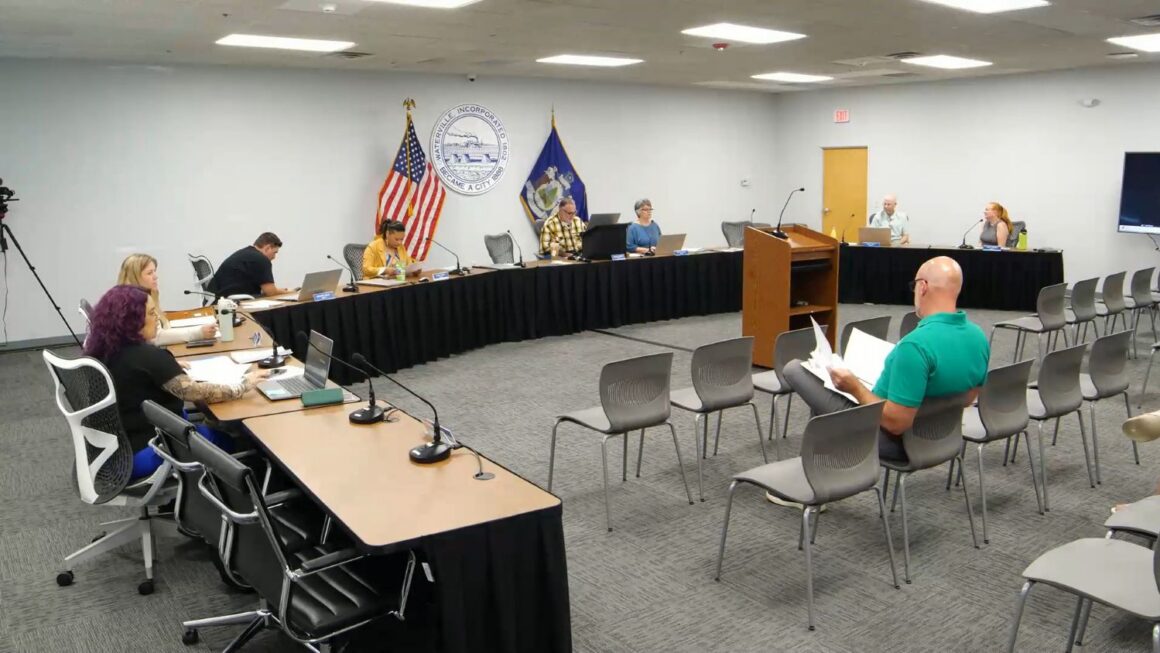
WATERVILLE — The City Council discussed a proposed $1.89 million project Wednesday to replace aging radio, dispatch and emergency communications systems serving communities across the region.
Dan Mayotte, a Waterville firefighter, presented the city’s congressionally directed spending application to the council during its Aug. 5 meeting. The application, submitted with support from U.S. Sens. Susan Collins and Angus King, seeks funding to modernize critical communications systems at the Waterville Regional Communications Center, or WRCC.
The project totals $1,892,865, according to City Council documents.
Mayotte told the council that some WRCC radios are more than 20 years old, with other equipment dating back even further, risking failure “at any point.”
Mayotte said the center uses a dispatch system that is computer aided and dates to the 1980s. He told councilors that many parts of the radio network have outlived their expected lifespans, and some equipment is no longer supported by manufacturers, making replacement parts increasingly difficult to find.
The need to modernize the system has grown as the WRCC has taken on a larger regional role. In mid‑2023, the center began operating as a regional dispatch hub, helping neighboring communities after several local dispatch services abruptly closed. The WRCC also serves as a public safety answering point, a 24‑hour center that receives 911 calls and directs them to the appropriate emergency responders.
Mayotte said the WRCC is the 12th‑busiest of Maine’s 25 public safety answering points. He told councilors the proposed project would update the center’s dispatch software and records management system, replace dispatch consoles and radio equipment and add a fire station alerting system.
The plan calls for a radio network linking the WRCC tower with sites at Colby College and the Waterville Regional Airport. According to the presentation, the expanded network would improve redundancy, resiliency and regional interoperability while allowing room for future growth.
Mayotte also raised cybersecurity concerns. He noted that the Augusta Police Department uses the same software now in place at the WRCC and was previously hacked and held for ransom.
“It’s just a matter of time before this infrastructure gets hacked,” he said.
Another major goal of the project is to improve communication among public safety agencies. Mayotte said the Police Department and Fire Department continue to struggle with the current radio system.
“Part of what we want to do is create a robust network in this city,” he said.
The project would involve 11 communities, with Waterville serving as the lead. The other participating communities are Augusta, Albion, Belgrade, China, Clinton, Hallowell, Oakland, Rome, Sidney and Winslow. Together, they have more than 70,000 residents, according to the presentation.
“I’ve been working on getting funding for four years,” Mayotte said.
The proposed timeline calls for planning, specifications and bid development in 2026, followed by bidding and procurement in 2027.
Installation of new infrastructure, deployment of the updated dispatch and records system, construction of the radio network and installation of the fire station alerting system would take place in 2027 and 2028, along with training and testing.
The council took no formal action Wednesday.
Councilor Rebecca Green, D‑Ward 4, questioned how actively the other communities in the regional system are communicating with congressional offices about the proposal.
“It’s great that this proposal has been submitted and approved,” Green said. “Are the other communities involved communicating with the congressional office?”
She said the regional nature of the communications system may also require involvement from additional levels of government.
“What I’m seeing is a continuing theme of call volume going up, more services are needed and Waterville seems to be stepping up and providing,” Green said. “I do think we need to look at other ways to involve not just other communities, but other jurisdictions. There should be county and state‑level involvement.”