



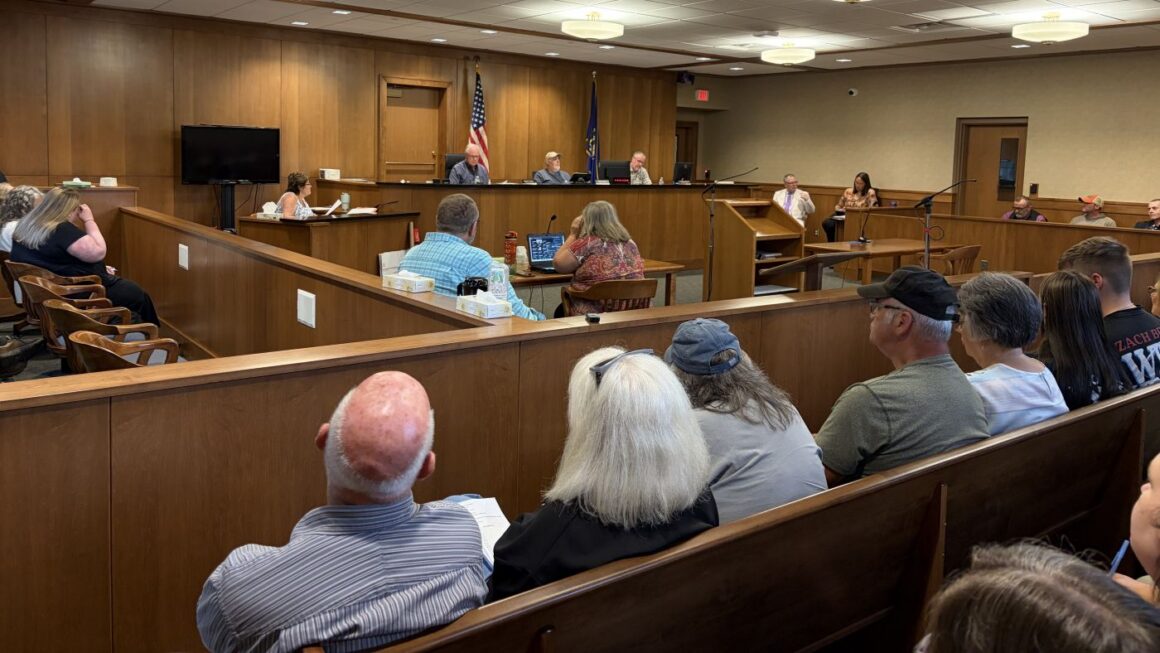
MACHIAS — Washington County commissioners ordered County Manager Renée Gray to vacate her office immediately Thursday during a confrontational meeting packed with her supporters.
The directive followed a July 2 special meeting where commissioners voted to terminate Gray effective July 22, just shy of her three-year anniversary on the job.
Gray attended Thursday’s meeting with Machias lawyer Jeffrey Davidson and threatened to sue the commission — and Commissioners David Burns and Billy Howard individually — unless they rescind the termination.
Gray cited whistleblower retaliation and violations of Maine’s Freedom of Access Act, state laws governing county manager terminations, and state and federal due process rights. Davidson gave the commission until July 10 — one day after the meeting — to rescind the decision.
Following a 50-minute executive session July 2, Burns and Howard voted to terminate Gray. Commissioner Courtney Hammond opposed the firing and declined to sign the termination letter given to Gray later that day.
The commission gave no cause for Gray’s firing, omitting it from the one-sentence termination letter.
Maine’s Freedom of Access Act, or FOAA, requires final written disciplinary decisions to state the conduct and facts underlying the action, alongside “the conclusions of the acting authority as to the reasons for that action.” Gray’s termination letter lacks this required information.
Burns did not respond to a written request from Monitor Local early this week asking whether the commission would issue a more detailed letter citing cause and conclusions.
During their regular monthly meeting Thursday, commissioners worked through a long agenda of spending items and department head reports before opening the floor to public comment.
Davidson took the podium first and read his three-page letter aloud, accusing the commission of violating Gray’s legal rights “in multiple ways.”
One violation, he said, occurred when the commission held the July 2 executive session to discuss Gray without her presence, as FOAA requires.
According to Davidson, the commission convened the executive session with Calais lawyer Dennis Mahar. After a brief discussion, Mahar left the room and invited Gray to join the commissioners. At that point, the commissioners asked Gray to resign, but she refused.
In his letter, Davidson noted the commission never held a public vote to hire Mahar. This omission made it “clear that one or more of the commissioners spoke to him about Ms. Gray’s employment status and contract in violation of public meeting laws” before the July 2 meeting, Davidson wrote.
Maine law requires boards to permit employees facing disciplinary action to attend executive sessions. The law also allows employees to request an open session for hearings on charges or complaints, a request the board must grant. However, Davidson said Gray did not know she was the subject of the executive session until after it began.
Davidson said secret meetings between one or more commissioners and Mahar before July 2 “were designed to conceal the events that Commissioners Burns and Howard had orchestrated to terminate Ms. Gray.”
“These acts may constitute civil or criminal offenses,” Davidson said, “and I have advised Ms. Gray to forward complaints to the appropriate agency for a full investigation.”
Gray served as deputy county manager and then county manager beginning in July 2023. Before that, she worked as the town administrator in Lubec and served six years on the Washington County Budget Advisory Committee.
Under Gray’s contract, her starting salary was $81,800 based on an initial six-month probationary period, and commissioners approved annual increases each year since. The contract requires a 20-day grace period between the termination notice and her final day on the job. It also requires the county to pay her full salary and benefits for 60 days after her termination, unless she finds other employment during that period.
Davidson said commissioners never gave Gray a performance review, despite a contract requirement for annual evaluations. He added that her personnel file contains no negative evaluations, records or complaints.
“No commissioner gave Ms. Gray any reason which would amount to a legal cause for her termination in the executive session,” Davidson said.
In addition to other violations, Davidson said the county ignored state law outlining a weekslong process of notice and public hearings before commissioners can remove or suspend an administrator for cause. The U.S. District Court of Maine has ruled that an employment contract cannot waive this required process.
After Davidson read his letter and a few residents spoke, Burns moved to pay Gray through the end of her contract July 22 but bar her from working.
“Since Ms. Gray has decided not to finish out the term of her office in a productive way,” Burns said, his motion allowed her to return to her office only to retrieve her personal belongings.
Howard supported the motion, while Hammond opposed it, drawing applause and murmurs of approval from the audience.
After the motion passed, several audience members loudly called for Burns and Howard to step down.
During her tenure, Gray managed a financial crisis in Washington County that resulted from years of mismanagement by former county officials. Previous administrations carried unspent funds into subsequent budgets without accurate accounting and failed to conduct annual audits, causing a $2.6 million shortfall in 2024. The crisis erupted in summer 2025 when county officials realized the debt could reach $8 million by the end of the year.
Commissioners asked the Office of the Maine Attorney General to review the financial crisis in October 2025, but no criminal allegations have been made.
Davidson said Thursday that Gray believes the commissioners terminated her because she held details about the mismanagement of county governance. He alleged that Burns and Howard committed several civil or criminal violations over the past 16 months.
“Those acts include numerous public hearing and records violations, financial mismanagement, sexually discriminatory and derogatory language directed toward her and other females in county government, such as being called ‘girls’ numerous times on the public record and being told that she should ‘not put away her waitressing skills,'” Davidson said.
Davidson also said that during a dispute May 28, Burns pointed his finger at Gray and told her she “would do what he told her to do or he would find someone else who would.” The exchange occurred the day after the commission held a workshop to discuss a spending freeze and updated job descriptions.
Gray believes Burns made that threat to intimidate, harass and silence her, Davidson said. He added that the commissioners’ attempt to deny her a public hearing and their violations of the termination process prove Burns carried out his threat.
According to Davidson, Gray also believes Washington County is attempting to silence her because of her ongoing cooperation with the Office of the Maine Attorney General to investigate potential financial crimes. Because of this, she claims whistleblower status and asserts that the termination notice is retaliatory.
Davidson claimed the county violated Gray’s due process rights under the state and federal constitutions. He added that Gray suffered reputational damage and severe emotional distress due to what he called the “illegal and intentional actions of Commissioner Burns and Commissioner Howard acting in both their personal and official capacities.”
Although the packed room had standing room left, just a few residents offered public comments following Davidson’s remarks.
David Bibber of Charlotte noted the unprecedented nature of the commission’s behavior.
“I have been involved in county and city politics for almost 40 years and watched county and city managers be terminated, but never have I seen any of them be treated like our commissioners treated Ms. Gray,” Bibber said.
Later in the day, Bibber said he felt “ashamed and apprehensive” about the county’s leadership, warning: “Now that Ms. Gray is out of the way, guess who now runs the county? The county commissioners. I suggest the citizens of Washington County pay close attention to the circus that has come to town.”
Gray’s aunt also spoke, asking Burns and Howard if they were “under the impression that any decision you make on this committee, that you are not held accountable for your decisions?”
“I think I can say for a good portion of Washington County, the age of hiding things is over,” she said, calling the decision underhanded. “Whatever you decide must be decided in public. It would be in your best interest to try to explain this decision.”
In response, Burns said there are two sides to every story.
“There will be an appropriate time and appropriate forum to hear from the other side, if you will, why this decision was made,” Burns said.
Raising his voice, Burns said he has been in public service for 50 years and knows his responsibilities.
“I’m not here to serve myself and neither should anybody be who is appointed or elected,” Burns said. “I’m certainly not in it for the money. I’m certainly not in it for the prestige. I’m certainly not here for the vacation, because it’s been anything but for the past year.”
Following his statement, Burns introduced the motion requiring Gray to vacate her office.