


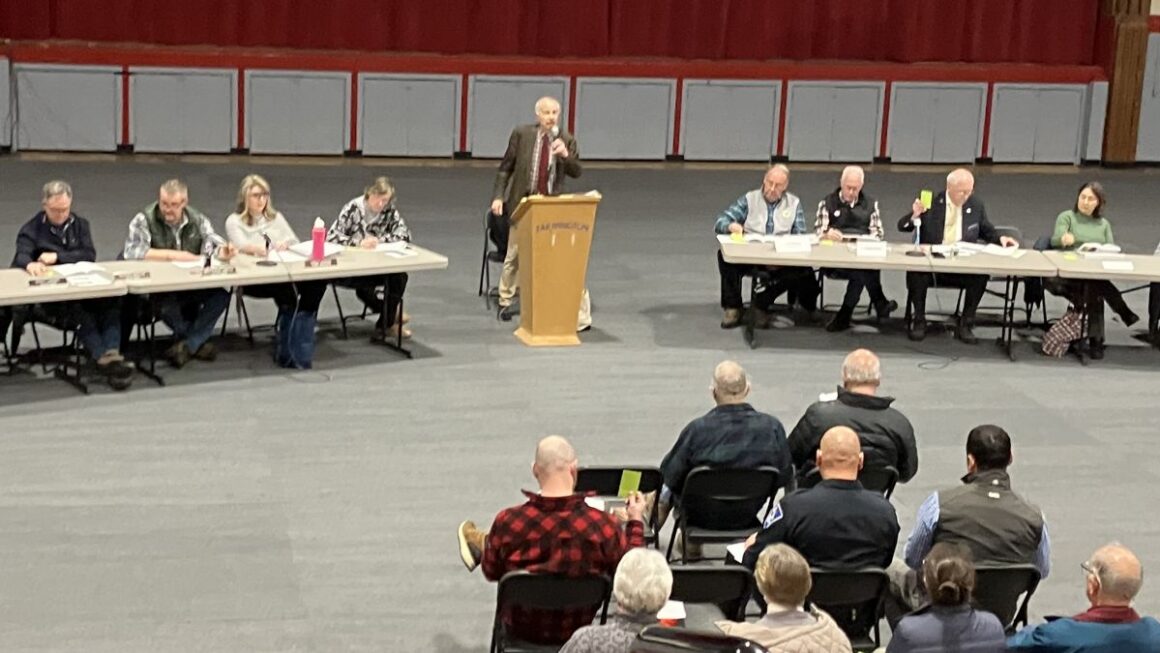
FARMINGTON — Residents are set to return to the Farmington Community Center on May 11 for the second town meeting in three months, with votes scheduled on buying a new fire truck, building a bridge over the Sandy River and approving a $16.6 million budget.
At a town meeting in late March, residents adopted a six‑month budget and approved a shift from a calendar year to a fiscal year running July 1 to June 30. The change aligns the town with school, county and state budget cycles and with many of its contracts.
Voters elected town officials in March, and the May 11 meeting will not include an election.
The Select Board is recommending a $16,580,989 budget for the next fiscal year. With an estimated $3.64 million in revenue, the town would need to raise $12.9 million in taxes — a 5.26 percent increase over the 2025 budget, the last full 12‑month budget approved in Farmington.
Officials project a tax rate of $12.10 per $1,000 of assessed valuation to raise the $12.9 million.
The 2025 tax rate was $10.50, but the town added $1.3 million from the undesignated fund after discovering an error that had set the rate too low. Without that one‑time infusion, the rate would have been $11.70 — 40 cents less than the projected rate for the coming year.
The tax rate for the current six‑month budget will be $5.47 — slightly below the projected $5.49 — after the Select Board set the overlay at $34,000 last week.
School and county assessments are the largest cost drivers in the recommended budget. Municipal spending makes up 45.1 percent of the total, with 44.2 percent going to Regional School Unit 9 and 10.7 percent to Franklin County.
The RSU 9 board of directors is recommending a budget that increases 1.5 percent, resulting in a $5.72 million assessment for Farmington. That is up 3.8 percent from fiscal 2026, which covers the 2025-26 school year, or 6.2 percent from the 2025 calendar year.
The county budget process is still underway, and Farmington is using a $1.38 million assessment as a placeholder. That amount would be 21 percent higher than the 2025 calendar year assessment.
Under the Select Board’s recommendation, municipal expenditures would rise 1.7 percent compared with the 2025 budget. Increases include higher software and utility costs and additional funding to cover volatile motor and heating fuel prices. There is no cost‑of‑living adjustment because the six‑month budget already included a 45‑cent wage increase to match the state minimum wage.
A $5,000 difference separates the board’s budget from the Budget Committee’s version. After the committee finished its deliberations, the board recommended adding $5,000 to the legal reserve due to increased spending from that account.
Beyond the budget articles and the standard items that authorize municipal officers to run the town, the warrant includes three new proposals.
The first would authorize the purchase of a new Pierce ladder truck to replace Tower 3, a 2007 Pierce model.
The town had planned to replace the truck in 2027 under its capital equipment plan, but increasingly long build times — now stretching up to five years — mean Farmington likely would not receive a new truck until 2030 at the earliest.
For example, the town voted in 2022 to replace its 1995 pumper truck. The new engine finished production and testing last month.
Article 32 would appropriate $745,000 and borrow another $1,582,183 — a total of $2.32 million — to buy the new ladder truck.
The initial appropriation would come from the Fire Apparatus capital account, which now has $515,145. As part of the town meeting’s Capital Reserves article, residents will be asked to add $150,000 to that account, as they have in recent years. The combined $665,000 would go toward the truck, with the remaining appropriation paid in fiscal 2028.
With an estimated 4.83 percent net interest rate on a 15‑year bond, the total bond cost would be $2.26 million.
The Select Board approved placing an order for the ladder truck in March to avoid further price increases. If voters reject the article May 11, the town will cancel the order.
Article 33 would cut in half the permitting fees charged to marijuana cultivation facilities. Fees vary based on several factors, including facility size and whether cultivation occurs indoors or outdoors.
Farmington now collects a little more than $29,000 a year from five marijuana-related facilities. If voters approve changes to the town’s Adult Use and Medical Marijuana Stores, Cultivation Facilities, Manufacturing Facilities and Testing Facilities ordinance, that amount would decrease to $14,575.
Supporters of the reduction cite lower fees in comparable towns and note that, under state law, municipalities may charge only what it costs to administer the licensing process, not generate revenue.
Article 34 asks voters to authorize borrowing up to $500,000 for construction of a multiuse bridge over the Sandy River. The project would connect the Whistle Stop Trail — a 14‑mile route from Jay to West Farmington — to Prescott Field.
The project sits on abutments and a central pier left from a rail bridge removed in 1989. It has drawn interest in Farmington since at least 2007. Supporters say the new span would give snowmobilers and other recreation users a safe way to cross the Sandy River and link downtown to trail systems throughout Franklin County and beyond.
An economic impact statement estimates the bridge could bring as many as 8,000 additional visitors to town each year.
The project is expected to cost up to $4.2 million. With the proposed $500,000 bond and a previously approved $200,000 from the Downtown Tax Increment Financing District, Farmington would cover about 17 percent of the total. Federal, state and privately raised funds would pay the rest.
A 10‑year bond at 4.5 percent interest would cost $631,894.
The town has scheduled an informational session for 6 p.m. Wednesday, May 6, at the Farmington Municipal Building.
The annual town meeting is set for 7 p.m. Monday, May 11, at the Community Center.