


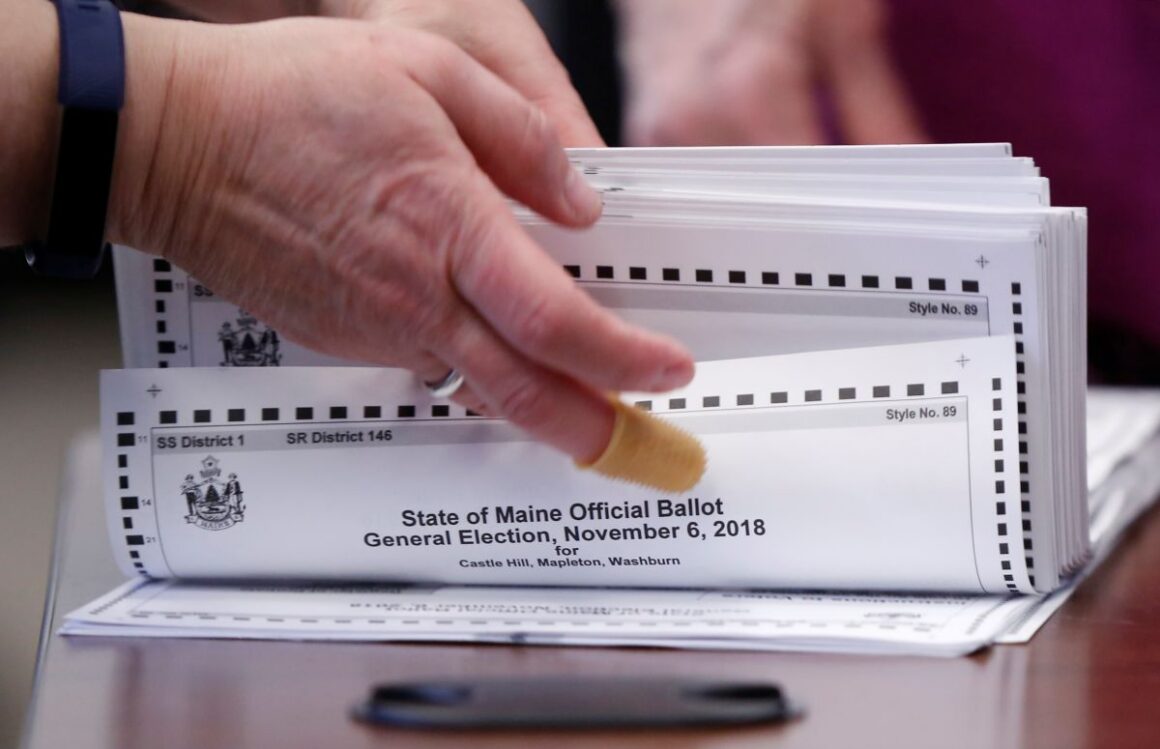
The June 9 primary election is rapidly approaching for Maine voters and the candidates looking to earn their support. Maine’s unique use of ranked-choice voting could be a big factor in some of the most prominent races.
Maine is one of only two states in the country, along with Alaska, that conducts some statewide elections using ranked-choice voting. This process allows voters to rank candidates by preference rather than selecting just one candidate, and allows for multiple rounds of tabulation until a candidate receives more than 50 percent of the vote. It is sometimes called instant runoff voting because the process avoids the need for a separate runoff election if a candidate does not immediately win a majority.
When Mainers first adopted ranked-choice voting via referendum in 2016, it was supposed to apply in both state and federal elections. But Maine’s Supreme Court has repeatedly advised that the ranked-choice process is incompatible with parts of the state Constitution that guide how general elections for state offices should work.
State primaries and federal races, meanwhile, are governed by state statute. That has resulted in a hybrid system where the ranked-choice approach is used in Maine’s primary elections for governor, the state Legislature and federal offices, and in federal races during the general election. But it is not used in state races during the general election.
The general election is still months away, and, for this primary season, ranked-choice voting will be used widely on the ballot.
What is ranked-choice voting?
In ranked-choice voting, which is used only when there are three or more contenders, voters can rank their candidates by preference rather than choose a single candidate.
If a candidate wins a majority of voters’ first-choice votes, they are declared the winner. But if no one gets more than 50 percent, that can trigger additional rounds of tabulation. The last-place candidates are eliminated, and their votes are redistributed to those voters’ next-ranked choice. That process repeats until one candidate secures more than 50 percent and wins the election.
Which elections will it be used in?
Ranked-choice voting will be used in all state and federal primaries that have more than two candidates on the June ballot. That means it will be featured in both the Republican and Democratic primaries for governor, the Democratic primary for U.S. Senate, the Democratic primary for Maine’s 2nd Congressional District and any State House primaries with three or more candidates.
The ranked-choice system could prove especially significant in the governor’s race, where there are crowded fields of candidates competing for each party’s nomination: seven Republicans and five Democrats.
The implications are factoring into the messaging in both party’s races – with some Republican and Democratic candidates already making appeals that they’d prefer to be voters’ top choice, but would also settle for being their second pick.
Ranked choice will be used in the Democratic primaries for U.S. Senate and CD 2 because each of those races has three or more contenders. It will not be used in the Republican primary for CD 1 because that race only features two candidates, Ron Russell and Joshua Pietrowicz, who are running for the chance to challenge incumbent Democratic Rep. Chellie Pingree.
Voters will not see ranked-choice voting on their ballot for county or municipal races, except in cities such as Portland and Westbrook that have chosen to use it to elect some local officials.
What does the recent Maine Supreme Court decision mean for the primary?
Some voters may be confused after a recent Maine Supreme Court advisory opinion once again found that ranked-choice voting is not compatible with the Maine Constitution when it comes to state general elections. But this ruling does not impact the use of ranked-choice voting in the primaries.
While the court’s opinion did essentially shut down a Democratic effort to extend ranked-choice voting to the general elections for governor and the State House, it didn’t change the status quo. That means ranked-choice voting is still being used for Maine’s state and federal primary elections on June 9.